David Unwin died in 11th February 2010 after a brief illness, aged 91, and was cremated in Golders Green Crematorium. The son of the publisher Stanley Unwin, he was born on 3.12.1918. It was as the writer for children, David Severn, that he earned early fame, his first book, Rick Afire coming out in 1942, the first of his 'Crusoe Books' featuring children's friendship with a young accountant called Robinson (hence 'Crusoe') who was escaping the office for a holiday in the open air. The writer and critic Geoffrey Trease once wrote (1964:141) that David Severn was an outstanding pioneer of the holiday themes after Arthur Ransome. These early books were outstanding, examples of outdoor adventure by resourceful and independent children with positive descriptions of a Romany group. His next series with the Warner family shows a similar free spirit, with more of an interest in gymkhanas and the country set. A journey through Africa produced My Foreign Correspondent through Africa in 1951, 20 illustrated news-sheets which were part of a wider series. He began to experiment with a number of different ideas. Dream Gold (1949) is a psychological thriller. Two boys begin to dream of events 300 years ago, connected to a wrecked ship in Cornwall. They begin to dream together in a way that transports them to a desert island where sailors are coming to blows. Each takes on the personality of their ancestor and fights out the dispute again. This risks the lives of both, and only one survives. In Drumbeats! pupils find a magic drum which they discover had been stolen by an ill-fated expedition to Africa in 1935. When Oliver beats it, the children are transported back to 1935 Africa and witness the lost expedition. The timeslip presents deadly dangers for the present, causing a fire in school. In The Future Took Us (1957) a time slip into 3000AD, a religious dictatorship (actually the headmaster's alter ego) whose holy book was a maths primer and who thought up mathematical executions ruled the land. He and his henchmen were overcome. Then came a story of a boy brought up by foxes and behaved like a fox. His young girl saviour did not seem to mind his nakedness. This sense of psycho-magic never left him, and two of his last books concerned a ghost girl, and a magic toy castle that became real.
David Unwin's early books were a much loved part of children's series fiction. His more challenging works featured in the school curriculum for a while. As tastes and publishers ambitions changed in the 1970s, he found less opportunities to be published and his last work was his autobiography, in 1982, Fifty Years With Father. Earlier, in the 1950s, he had tried his hand at adult fiction. These focused on wives who ruled the roust, influencing politics (The Governor's Wife) as well as domestic life (A View of the Heath).
David Severn was involved in the early days of writing about ghosts, magic and the supernatural in a naturalistic way. Magic is presented as part of life. We can all slip into other times and other worlds, and many writers have done this since. But David Severn concentrated on the psychology of this. Dream walking out of the body experiences, reliving deep obsessions which continue to damage the lives of descendants. Treachery sticking to objects (the drum) and needing to be resolved and avenged. The totalitarian power of teachers and headteachers. The savagery shown to animals (foxes) highlighted only by making the fox cub a human. These titles from his middle period were thought provoking indeed. His last two children's books highlighted magic or the supernatural. A boy's obsession with a dead girl is described as giving strength to her ghost, to the extent that others saw her as a real girl. The Girl in the Grove is deeply psychological, with a brilliant twist at the end - the earlier family history in the effective management of slaves (a euphemism for working the slaves to death). The Grove, which typified the moneyed class, had blood on their family hands so could not rest in peace. His last book, The Wishing Bone, is great fun - what to do with three wishes. The wishes go wrong because of careless speech, but in the end making the wish is seem as itself the first step towards fulfilment. To wish to be friends with enemies is the first step towards repairing bridges. Story-book wishes have horrendous consequences, as the children get embroiled in siege and battle. But real-life wishes are a healing mechanism important in creating a harmonious world.
David Unwin leaves me with happy memories both of reading his work as an academic and corresponding with him. It is time for some of his titles to be resurrected.
See further: http://eprints.worc.ac.uk/236 for a detailed description of his books.
Monday, 22 February 2010


Sunday, 21 February 2010
Golding, Lord of the Flies.
Readers of Lord of the Flies or viewers of the film, will remember the twins. They were real kids in Golding's class in Bishop Wordsworth School in Salisbury in the late 1940 to early 1950s. One twin is my neighbour; the other's funeral took place on Friday. Rest in peace and love to the family.
See also http://learnlivethrive.blogspot.com/2009/11/tony-brown-and-william-golding.html
See also http://learnlivethrive.blogspot.com/2009/11/tony-brown-and-william-golding.html
Friday, 12 February 2010
Escaping Wartorn Europe
This post describes three books written between 1940 and 1945 which describes children fleeing through France in the early years of the war. They are: Olive C Dougan, Schoolgirls in Peril (1944); Agnes M. Miall, The Schoolgirl Fugitives (1942); and Nevil Chute, Pied Piper (1942).
Olive Dougan also wrote The Schoolgirl Refugees in 1940. Very scarce. I am still looking.
Dougan tells the story of a school in a Flemish speaking area just before 1939. The Nazis were pressing into Holland and Belgium. The school moves to Brussels and is soon closed down, and the Head arrested. The main character Sally overhears a traitor's plot to allow the Nazi army to invade. Sally is thereafter a marked girl and sent to her fascist uncles in Brittany with her young sister Betty. Their father is a journalist collecting sensitive evidence, a target for the Nazis. There they are abused and miserable. Escape routes exist in the area and all goes well until an airman is helped to escape and his clothes and parachute are found. The sisters have to flee on foot or with local help to Vichy France and towards the Spanish border. A bete noir is Tilda Weil, a German girl with serious Nazi relatives. She boasts of victory, and spies against her school and against a Jewish fellow pupil with links to the resistance. Tilde is emotionally fond of little Betty, and after her new husband is killed by the SS for protesting, she crosses over to help the girls to escape to Spain. The Headmistress is already there. They make it back to England for a grand reunion, after the Americans hand entered the war but before D day. Oh, and the girls are reunited also with their parents.
The detail of anti-Nazi feeling is outstanding - the little things ordinary people will do to undermine the enemy. The Nazis are painted as a powerful elite who rule by fear and repression. Ordinary Germans are decent, especially when they understand the reality of what is going on. This is propaganda; most ordinary Germans did not cross the road to defend victims since their own lives were endangered by doing so.
Then endgame is disappointing. Prolonged struggle happens until the last few chapters, then, all of a rush they make it to Spain, find a boat, and arrive in England. This part is very much a 'happy ever after' epilogue.
Unfortunately my copy was bound without pages 97-112. I will be grateful if anyone can send me photocopies.
Agnes M Miall. The Schoolgirl Fugitives.
Kay, aged 14, and elder cousin Reba, 19, in school in southern France, is faced, as the German army takes over Belgium, to set out on a 360 mile walk to Bordeaux. "Happy go lucky" parents were away working in Canada, not believing that a war was in the offing. French relatives lived in the thick of the fighting, so Bordeaux gave them a chance to find a boat to England. They would have to go alone, unescorted, and travel light, leaving most of their possessions behind. The first leg was in an ambulance: the roads are crowded with refugees, so main roads had to be avoided and slow progress made on back roads. The refugees included children in tatters, with blisters, looking after babies. It was a vast line of mainly women and children. For Kay it was fun, different. They decide to keep off the main roads because German planes were machine gunning the refugees. They are fed at a farm, who lets them have the address of relatives further on. There is a strong theme of French kindness to the English, probably, the book thinks, because they were ashamed of letting their allies down. Unable to board a train (really cattle wagons) they took possession of two bicycles that had to be abandoned by people getting on the train. The train was machine-gunned so they had a narrow escape. Nazi planes machine gunning the trains and main roads become a significant theme, making the girls keep to the side roads. They were encouraged to avoid Bordeaux by what seemed to them later as a fifth columnist, spreading despair around. They almost ran into a German outpost, managing to pick up a German map which helped them. They find little Francoise, separated from her mother; and Kay gets lost. However, within a particularly surly group, Rebe was accused of being a German spy and locked up. Meanwhile Kay had stumbled over a man dressed as a German soldier, which after a nail-biting time turned out to be Eric, an escaping English soldier. They travel together, find Reba again, now imprisoned, and let her out and they all escape from that hateful town. Bordeaux is now closed, so there destination is a port near the Spanish border. Francoise's mother has left a letter indicating where to find her. The French government has meanwhile capitulated to the Germans, so there is no time to lose. On the coast, out swimming, they rescue a woman drowning after an attach of cramp, who Francoise soon identifies, of course, as her mother. Her mother's friends have a yacht and they manage to leave safely.
Nevil Shute, Pied Piper.
Shute, an aircraft engineer and founder/owner of Airspeed, wrote a novel a year throughout the 1930a to 1950s, and his war efforts reflect the anxieties of those days. Pied Piper tells the story of an elderly unpreposessing and unheroic man, Mr Howard, who decides to return to England from the French alps, but finds the trains disrupted and roads clogged. A simple journey takes on nightmare proportions. Moreover, he is persuaded to take two young children with him, Ronnie and Sheila, to relatives in England. This is a book for adults about children, not a story for children. The children are incumbrances, dependants, not young heroes as they would be in stories for children. At Dijon, 10 year old is added, Rose, trying to reach her father in London. Howard comes across as a man doing what he has to in times of trouble, a hero indeed but not heroic, often anxious, obsessed with the safety of his fishing tackle. On the road, Pierre joins them, a 7 year old being stoned by villagers as a German spy. (The French are described as an unpleasant rabble, for the most part). Then comes Willem a little Dutch boy, whose parents are blown to pieces when a Nazi Stuka bombs refugees on the road, the rear gunner laughing as he machine-gunned the hoards of women and children. Nicole joins the group in Chatres, the fiance of his dead son John, then a kitten. They eventually make it to the coast. A 10 year old Polish Jewish boy joins them, Marjan, to keep him from becoming a slave. There is a sticky moment near Brest when Mr Howard is arrested as a spy after a British success, and taken out to be shot (but we readers know from page 1 that he survived). The theme of the book is that the British take care of children even if they are not related, to the utter astonishment of the French and Germans. He is a Pied Piper in reverse, taking a group of children to safety - oh, and he makes them whistles from hazel twigs to represent the piper's pipes. Finally there is Anna, but for the twist at the end of the story that brought Anna into the group you will have to read the book for yourself.
The representations of Germans are mixed - the typical soldier is tired and grey faced. No one laughed light-heartedly. The rear gunner shooting civilians is cock-a-hoop, laughing and excited. The Gestapo officer is brutal, harsh, cynical, not believing that a man would risk his own life for strangers, or that his daughter in America would willingly look after the waifs and strays. His son the tank commander, now dead, was annoyed that the road was clogged with refugees and happily shot at them to clear the road. There is no humanity, no fellow feeling or empathy. They were convinced of their own invincibility, sure they would be in London in six weeks. The representations of the British were that they are strong-minded and eccentric, moral to the point of self-sacrifice, ensuring that others are not implicated even if it was to their disadvantage. The French are self-seeking and short sighted for the most part, willing to stone a small boy as a spy, and to give away a Jewish labourer to the authorities. Helpful acts such as sailing them home had to be paid for, and to serve other selfish interests.
Postscript: in 1940, households in Britain received a government circular on a flimsy piece of thin A5 paper, What to do if the invasion happens. They are told to stay at home and wait for guidance, do not clog the roads so the army cannot get around to fight the enemy. The French example is given: if you become refugees on the road, you will be shot at by Nazi aircraft and tanks.
Thursday, 4 February 2010
Malcolm Saville, 1901-1982. Children's Writer.
A collection of the following papers by Stephen Bigger can be found on http://eprints.worc.ac.uk/800. Some letter can be found on http://eprints.worc.ac.uk/799
These are revisions of orginals published by the Malcolm Saville Society. Copyright: Stephen Bigger, 2010.
Part 1. The Emerging Author
1. D J Desmond: the Anonymous Author. 2005
Malcolm Saville wrote occasionally under this name, and these works are discussed.
2. Malcolm Saville at My Garden Magazine. 2005
3. Apprenticeship: Malcolm Saville and David Severn 2003 The literary relationship between two beginning writers.
4. The Influence of J M Barrie on Malcolm Saville 2004 Malcolm Saville was fond of Dear Brutus by J M Barrie and this influenced his characterisation. 2004.
5. Did Malcolm Saville know W.E. Johns, author of Biggles? 2009.
Part 2. Values
6. Families in Difficulties
7. Romany Secrets: The depiction of Romanies in the writings of Malcolm Saville. 2002
8. Children Coping - Welcome the Jillies. 1998
9. Yellow Peril? The Depiction of the Chinese in the Fiction of Malcolm Saville 2002
Malcolm Saville's depiction of Chinese residents of Docklands.
10. Good People Working Together: The Lesson of Sea Witch Comes Home
Part 3. Locations
11. Why Choose Blakeney? Birds, Artists and Holidays in Digs. 2002 Post-war holidays and Malcolm Saville’s Jillies series.
12. Coping in dangerous waters: defining gender roles in the Ely Floods 2003 Relationships in The Luck of Sallowby (1952), Malcolm Saville’s fifth Jillies book, set in Ely floods.
13. Romanticised Landscape: Malcolm Saville’s Cornwall Real and fictional topography in Malcolm Saville’s Flying Fish Adventure 2003
14. Sea Watch at Southwold. 2004
Comparison of historical detail of the 1953 North Sea ‘great storm’ with Malcolm Saville’s Sea Witch Comes Home. Easter 2004.
15. Dartmoor, Flying Saucers and Military Secrecy 2005.
Links between flying saucers in two Saville stories, and other science fiction literature.
16. Muker, North Yorkshire: The Mysteries of Muker: Or Which Steps, Which Barn and Which Crackpot?
Part 4. Life in the 1940s
17. Spirit of the Place: Writing about England.
18. Small Creatures, and the Truth in a Tale Series. Nature writing.
19. Railways of Adventure. The place of railways in Malcolm Saville’s fiction. 2004 and 2007.
20. Harvest Holiday: A Happy Return to Townsend Farm. 2008
21. A Death in Normandy. The background to Mary and Michael’s father. 2009.
Thursday, 7 January 2010
Eileen Marsh, A Walled Garden, 1943.
I have given background information on Eileen Marsh earlier in this blog. A Walled Garden is one of her novels for adults, but is about children. She rated her adult fiction highly as artistic work. Her children's stories were quickly written with simple plots and characterisation. A Walled Garden in many ways resembles the later Goodnight Mr Tom. After an account of village life through the 1920s and 1930s, evacuees arrive in a Kent village, including one poor ragged boy terrified of his mother, who had run off by attaching himself to a school party. He is taken in by the book's central character, Catty, an unmarried woman whose first love had gone to America, while she looked after her grumpy father. She is presented as helpful to every one, taken for granted, and generally thought to be an unfulfilled soul people were sorry for. The two bonded closely, and the boy's health and confidence improved. He was a street urchin with colourful language, but he was her project, protected fiercely. He gradually improved his diction by copying posh members of the village (and that could cause trouble), and he won a scholarship to secondary school. Catty managed to bring him back for holidays when he was billeted away in Ashford. Another family, the Evans, was billeted with Catty, three children who are background characters. One theme of the book is how badly the London parents dressed and fed their offspring, and how much better they were in their billets. The Evans' parents took their family back to London, where they were promptly killed by a bomb. Catty's beau and his son (he was a widower) returns with the GIs, 20 years after he had once proposed.
The story was written shortly after the evacuations had taken place. It hoped that the experience of separation from birth families had had positive benefits to the children. This is part of countryfolk's horror of working class urban life and priorities. It was somewhat blind to the social inequities that caused urban poverty, and the more limited possibilities of self sufficiency through gardens and smallholdings.
The story was written shortly after the evacuations had taken place. It hoped that the experience of separation from birth families had had positive benefits to the children. This is part of countryfolk's horror of working class urban life and priorities. It was somewhat blind to the social inequities that caused urban poverty, and the more limited possibilities of self sufficiency through gardens and smallholdings.
Monday, 30 November 2009
Malta and Greece: Josephine Blackstock
Josephine Blackstock (died 1956) was from Oak Park, Chicago, Illinois, where she made her name before and after the second world war in education, being director of parks and playgrounds 1921-1951. She therefore was interested in how children learn from experience. American first editions are by Puttnams, Wings for Nikias with a foreword by Cimon Diamantopoulos, Minister of Greece and reissued after the war as a school text by EM Hale & Company of Eau Claire, Wisconsin. Both were issued in Britain by Hutchinsons, with Busoni's graphic illustrations in Island on the Beam replaced with tamer and more Anglicised pictures by R. Mills. Illustrations below are by Busoni. Blackstock wrote other educational texts after the war, mainly about famous lives. An extract from Nikias can be found in Youth replies, I can: stories of resistance, edited by May Lamberton Becker, Foreword by Elizabeth Morrow, illustrations by Warren Chappell (http://blacklight.betech.virginia.edu/catalog/u1302828).
Wings for Nikias: A Story of the Greece of Today, 1942
This is her first war book (written 1940, drawings by Rafaello Busoni with vivid lines, dedicated to Percy Boynton, = Percy Holmes Boynton, Prof. of English at Chicago University , died 1956). The story tells of a very small Greek boy who worked for the resistance against the Nazi invader and was rewarded by an aeroplane trip, which furthered his dreams of becoming a pilot. The dedication suggests that she told the story before deciding to publish, so that Nikias might be based on a real person. The UK version was by Hutchinson, retaining Busoni’s illustrations.
Nikias is 10. He is friends with a shepherd who tells him stories of ancient Greek tales, interesting as a device because the shepherd, Demetrios is able yet poor, living in a home-made tent, though with plans for marriage and something more permanent. The tale of Perseus results in Nikias dressing up with winged shoes in a carnival, Demetrios making him a toy plane, and then seeing a real plane go over, a rare sight there. In the background, war threatens.
The war erupts. An invading army takes over, and Demetrios joins the resistance army. Even the youngsters have to be alert. Nikias meets the invaders and realises that thie questions might give away Demetrios’s position. So he lies, and rushes to find the resistance forces and warn them. His prompt action results in a stirring victory for the resitance over the invaders. As a reward, he gets his flight in an aeroplane.
Review by The Chicago Tribune, of Wings for Nikias, cover flap of Island on the Beam::
"This charming story can hardly fail to accomplish three services for boy and girl readers: encourage bravery, heighten an already lively interest in aviation, and restore the shining traditions of ancient Greece. Mrs Blackstock's intimate knowledge of children - she is the director of playgrounds in Oak Park, Illinois - does not find its sole vent in practical psychology. She is a versitile writer, a born storyteller and a teacher of great skill..."
Island on the Beam: A Story of Malta. 1944.
 Dedicated this time “for Edith”, this story is about Malta, that crucial base which defended Mediterranean shipping and was intensely bombed. It is illustrated again by Rafaello Busoni. My English edition is by Hutchinson, in the Stories for Young People series, and dates to 1948. The illustrations have been replaced with more English but less lively drawings by R. Mills. The originals are graphic, with fighters straffing the streets and one character killed by a bomb. This was probably felt to be too graphic for English children who had experienced it, as American children had not.
 The story opens with a harmonious friendship between British and Maltese children and their families. The governor was General Dobbie, really Lieutenant-General Sir William George Shedden Dobbie GCMG, KCB, DSO (12 July 1879 – 3 October 1964), who had served in the Boer War and the First World War, and was the uncle of Orde Wingate who organised the Chindits behind Japanese lines in Burma and was killed in 1944. Both can be found in Charlton Cemetery. Dobbie (Old Dob-Dob in the book) was only 60 in 1939, when he was retired after governing Malaya for six years; but he persuaded Edmund Ironside that he had more to contribute and was sent as Governor-General of Malta till May 1942. He was replaced by the Anglo-Irish Lord Gort (Field Marshal John Standish Surtees Prendergast Vereker, 6th Viscount Gort VC, GCB, CBE, DSO & Two Bars, MVO, MC (10 July 1886 - 31 March 1946), hero (perhaps) of the BEF in France, builder of a new and vital airstrip on Gibraltar, who served in Malta from May 1942 until 26 September 1944. He appears in the book as a zealous reforming figure, suggesting that Dobbie might have needed replacing.
 The statue of Queen Victoria (‘Old Ma’) punctuates the story, surviving air attacks. Malta is part of a benevolent British Empire. The book caricatures national types. David is English, an intrepid pilot (officer pilot rather than sergeant pilot) of unbelievable luck, who loves polo. Sandy is Scottish, full of och the noo and porridge. Bob is American, brash and brazen, full of unintelligible slang, and linked throughout the story to convoys that do not get through. They all get on well, and Sandy marries the Maltese Tessa and twins are born. The Maltese children are Pietru (12) and younger Geckos who is obsessed with animals. John is Pietru’s age and friend, and sister Iris is Geckos’ friend. All goes well until a relative, Beppo, of Sicilian (Italian) birth stirred up trouble, caused a breakdown in their friendship for a while, and tried to steal a military secret. John is too full of his Englishness and imperialism (only an American could comment), and further annoyed when Pietru lost him a donkey race (Beppo had pushed him). Nevertheless, Beppo failed and escaped back to Italy. Uncle Umberto, Beppo’s relative, was anti-British at first, especially under Beppo’s influence, but apologised and made good. He is killed in the end saving Iris from a German bomb. Beppo represents the fifth column, the enemy voice from within; Umberto is a reminder that not all aliens are enemies.
 The story has a chronology. The first part is 1940, early in the war when only the four Gladiator biplanes defended the island. When three are left, they are nicknamed Faith, Hope and Charity. David flies Faith; and faith is a theme of the book. The detail of this period is sparse, and the Gladiators are not well described. (The picture of page 129 is actually of a Hurricane). They were described more heroically after the war. Later in the book, Tessa had married Sandy, twins were born and Pietru was 14 – we are now in 1942-3 and Lord Gort was Governor. David is flying hurricanes (Mosquitos arrived 1943-4), but again without detail – only the strategy of flying high and swooping down.
 Bob is to me a significant character, an American, with Chicago often mentioned. The guns are Chicago Pianos, as they were made in Chicago (lease lend). The children write to him, he meets their families and provides treats, his slang is mimicked. The author, teaching children in the Chicago area, has introduced into her story probably her major source, a friend who regaled her with stories of his wartime travels. Within the war, it allowed her pupils to get a feel of the human cost, and heroism, of war. The leverage to get them published gave first American then British readers a window into war in distant countries.
 Jacket of British edition, 1948.
The book ends problematically. Historically, the biplane Gloster Gladiators, probably six or more, including Faith, Hope and Charity, saved the day against extraordinary odds until the hurricanes were delivered by the convoys. That was a real David and Goliath story. However, in this book, there are Hurricanes and Wellingtons available, yet David chose to fly in an elderly Gladiator, a fighter not a bomber, to bomb the Italian post and airfield that was threatening Malta. That was crazy, when (apparently) a Wellington was already fuelled and bombed up. He gets shot down in the sea, saved only by his inflatable jacket and Pietru miraculously finds him. Tension is created at the expense of realism. The given top-speed is accurate though, 250 mph or so. The danger finally receded as Rommel was defeated in Africa and the allies won back control of the Mediterranean. Actually, Spitfire Vs, Beaufighters and Blenheims were stationed on the island, some from the Carrier HMS Eagle.
As a postscript, HMSO produced a booklet on the Siege of Malta as part of its effort to keep the population informed about the war. I have described this elsewhere since, although anonymous in authorship, it was actually written by the poet John Pudney who was a writer in residence serving in the Mediterranean theatre. This account of the struggle against inhuman political policies is an example for us all to continue the struggle to achieve ethical governance.
See also:
The story of Rafaello Busoni and his wife Hannah, Jewish refugees from Germany to New York in 1939 - http://www.archive.org/details/hannahbusoni2
Alan Machin's personal story:
http://alanmachinwork.net/Hunting-the-Gladiator-and-the-Gecko
 Thanks to Alan Machin for this and the conversation about "on the beam" which in air force slang means finding and sticking to the beams which assists navigation and landing. A relative, Wilf Slack, was i/c a number of coastal radar stations which used Gee and Oboe to get planes to target and home again. As night and daytime raids increased, night and fog landings became matters of great concern. All were of course top secret, but the slang "on the beam" began to be used. Germany also had a beam, Knickelbein, which Allied boffins succeeded in (metaphorically) "bending" sending German planes off target. My problem with this explanation for our title is the date of writing, 1943. Nevil Shute's Pastorale (1944), written by a flying expert who founded the aeroplane manufacturer Airspeed and built planes for the war government, tells of a Wellington bomber pilot finding his way home with a mutilated plane. We get a detailed description of the flight home and the landing, including the radio conversation. No beams are mentioned, anywhere. The beams may just have been in use, but without sufficient time for the slang to have developed and crossed to Chicago to be recognised by street kids. The phrase is clearly fully understandable by the author's Chicago audience, without need for explanation that might help us. In my copy of the American edition, the author writes 'To Della -whose friendship I have always found to be "on the beam"'. Full of sunshine and happiness. The beam was black slang for sunshine (Cassell's Dictionary of Slang). 'On the (sun)beam'. In the American version, Pietro sees how beautiful the island is, and says 'The island on the beam!". The happy sunshine isle. The illustrator Raphaello Busoni adds a little vignette - seven children in a Maltese boat, waving, with the island behind them bathed in sunshine. So then, if "on the beam!" is already American slang for sunshine and happiness, how fitting for it to be applied by Flying Fortress crews to getting home safely, especially where they are assisted by a navigation beam.

Wings for Nikias: A Story of the Greece of Today, 1942
This is her first war book (written 1940, drawings by Rafaello Busoni with vivid lines, dedicated to Percy Boynton, = Percy Holmes Boynton, Prof. of English at Chicago University , died 1956). The story tells of a very small Greek boy who worked for the resistance against the Nazi invader and was rewarded by an aeroplane trip, which furthered his dreams of becoming a pilot. The dedication suggests that she told the story before deciding to publish, so that Nikias might be based on a real person. The UK version was by Hutchinson, retaining Busoni’s illustrations.
Nikias is 10. He is friends with a shepherd who tells him stories of ancient Greek tales, interesting as a device because the shepherd, Demetrios is able yet poor, living in a home-made tent, though with plans for marriage and something more permanent. The tale of Perseus results in Nikias dressing up with winged shoes in a carnival, Demetrios making him a toy plane, and then seeing a real plane go over, a rare sight there. In the background, war threatens.
The war erupts. An invading army takes over, and Demetrios joins the resistance army. Even the youngsters have to be alert. Nikias meets the invaders and realises that thie questions might give away Demetrios’s position. So he lies, and rushes to find the resistance forces and warn them. His prompt action results in a stirring victory for the resitance over the invaders. As a reward, he gets his flight in an aeroplane.
Review by The Chicago Tribune, of Wings for Nikias, cover flap of Island on the Beam::
"This charming story can hardly fail to accomplish three services for boy and girl readers: encourage bravery, heighten an already lively interest in aviation, and restore the shining traditions of ancient Greece. Mrs Blackstock's intimate knowledge of children - she is the director of playgrounds in Oak Park, Illinois - does not find its sole vent in practical psychology. She is a versitile writer, a born storyteller and a teacher of great skill..."
Island on the Beam: A Story of Malta. 1944.


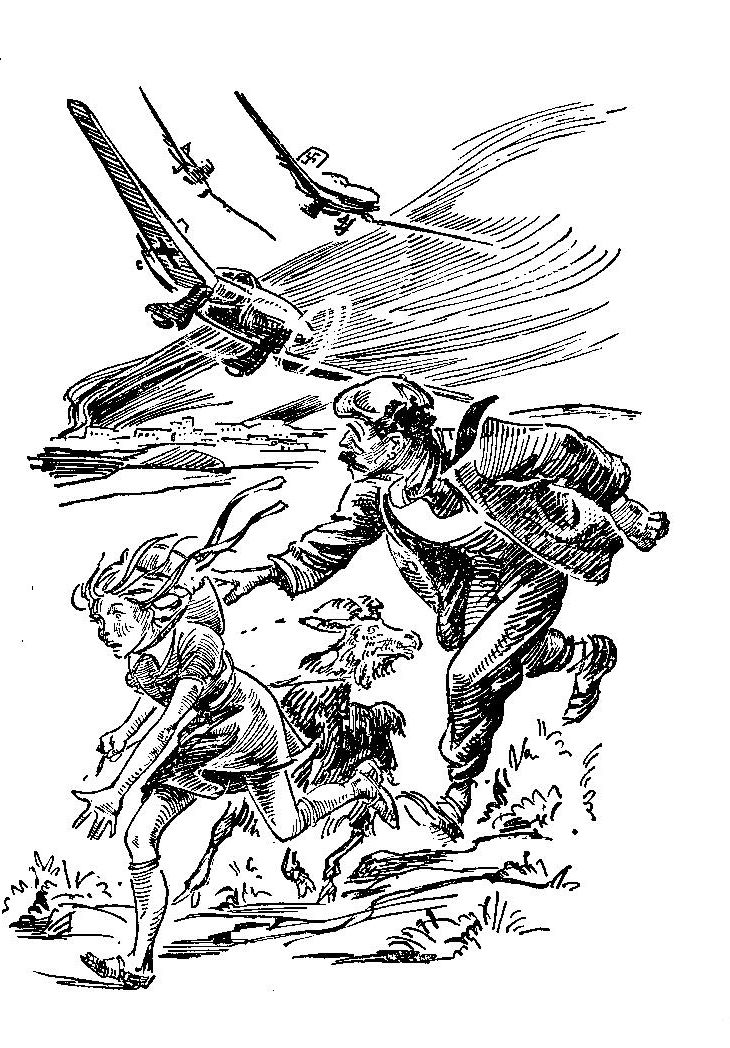


The book ends problematically. Historically, the biplane Gloster Gladiators, probably six or more, including Faith, Hope and Charity, saved the day against extraordinary odds until the hurricanes were delivered by the convoys. That was a real David and Goliath story. However, in this book, there are Hurricanes and Wellingtons available, yet David chose to fly in an elderly Gladiator, a fighter not a bomber, to bomb the Italian post and airfield that was threatening Malta. That was crazy, when (apparently) a Wellington was already fuelled and bombed up. He gets shot down in the sea, saved only by his inflatable jacket and Pietru miraculously finds him. Tension is created at the expense of realism. The given top-speed is accurate though, 250 mph or so. The danger finally receded as Rommel was defeated in Africa and the allies won back control of the Mediterranean. Actually, Spitfire Vs, Beaufighters and Blenheims were stationed on the island, some from the Carrier HMS Eagle.
As a postscript, HMSO produced a booklet on the Siege of Malta as part of its effort to keep the population informed about the war. I have described this elsewhere since, although anonymous in authorship, it was actually written by the poet John Pudney who was a writer in residence serving in the Mediterranean theatre. This account of the struggle against inhuman political policies is an example for us all to continue the struggle to achieve ethical governance.
See also:
The story of Rafaello Busoni and his wife Hannah, Jewish refugees from Germany to New York in 1939 - http://www.archive.org/details/hannahbusoni2
Alan Machin's personal story:
http://alanmachinwork.net/Hunting-the-Gladiator-and-the-Gecko


Tuesday, 24 November 2009
Jan Maclure, Escape to Chungking
This book was published early in the war. My reprint is 1942.The copyright libraries indicate a 1942 date for the first edition.The contents deal with the fall of Malaya and Singapore to the Japanese, in 1940. Jan Maclure is an unknown, and produced no other book under this name. She dedicates the book to friends who have not yet got out.
This is a powerful book. A 14 year old boy discovers that his mother is party to hidden military secrets in Japan, just entering into the second world war. The boy finds his mother's friend nearly dead after trying to take secrets to the British and is handed a package before the friend dies. He takes this on a long journey from Japan to Chungking in China where the British still ruled, mainly to carry the formula for a new kind of explosive.
The boy, Christopher or Kit, is on the run throughout the book. Every safe house has been exposed and the people arrested. Kit changes identity when his friend is killed in a volcanic explosion and he takes over his papers an identity, and he can cross to China as a Korean which he could not have done as English. The detail is accurate throughout, with Jananese language as well as geography. Within China he moved from Cowloon to Chungking pretty quicky, personally shooting down a Jananese fighter in the process when the gunner was injured.
The author clearly knew the far east, and dedicated the book to friends who had not escaped yet. Children who were fluent in English and Japanese must have existed. The ex-pat community in 1939 must have had some difficulties. This book for children brings not much solace, for the Japanese were victors. Some Japanese are nice, but en masse they are bad. This is a clear message. The army was bullied into compliance. Christopher showed that resistence should be to death, and that death was fine so long as it came out of patriotic ethical effort and not from giving up.
Subscribe to:
Posts (Atom)

 Posts

